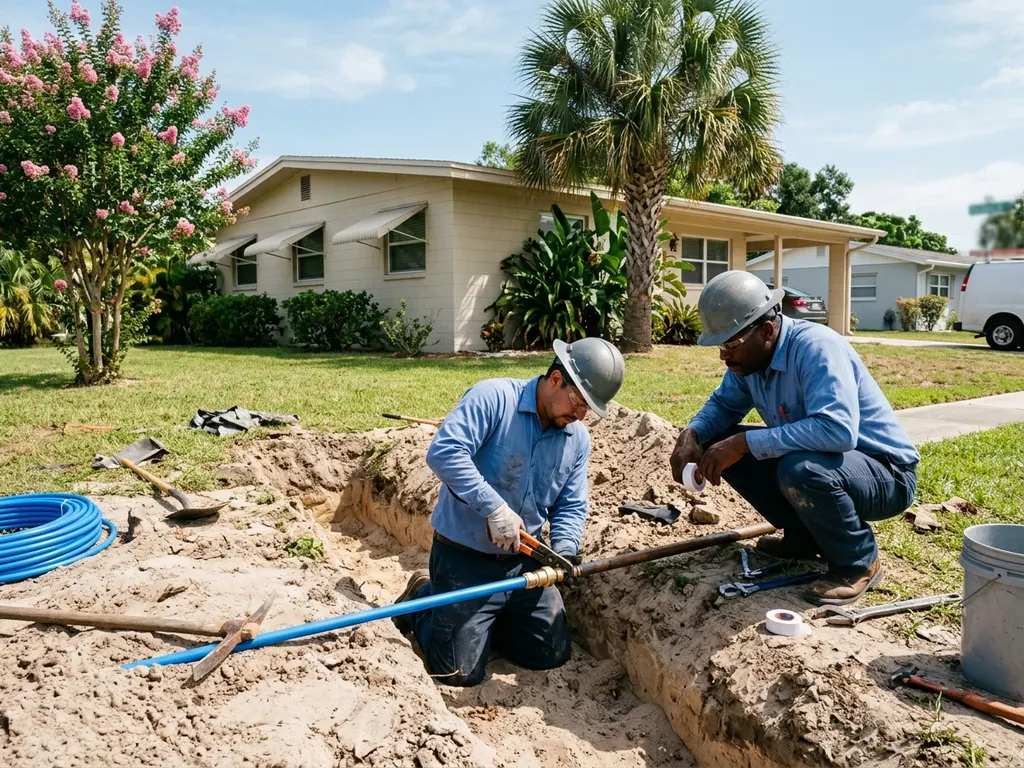
Main Water Line Leak Repair in Florida comes with a written scope and a fixed price before work begins. That consistency is why homeowners request Main Water Line Leak Repair in Florida by name.
The 30 to 100 feet of buried pipe between your meter and the front of your house is doing the heaviest lifting on your property — and it's the one most homeowners only think about after a wet spot appears in the front yard or the water bill triples. We carry four repair methods on the truck (pipe bursting, CIPP lining, horizontal directional drilling, and open-trench) and pick the right one based on your pipe material, depth, length, and the specific Florida soil under your lawn. Most repairs finish without disturbing your driveway, mature oaks, or sprinkler system.
A typical Florida service line runs between 18 and 36 inches deep, enters the house through a sleeve in the slab or stem wall, and connects to your home's pressure regulator. Each junction is a failure candidate.
Owned by the water utility. Anything between this box and the curb is theirs to fix. Anything on YOUR side of the meter is your problem.
Your manual emergency shut-off. Usually a 1/4-turn lever or a key-operated valve in a small green or black box near the meter. Test it once a year.
30–100 ft typical. Buried 18–36" deep. Material depends on construction era: copper (50s–90s), polybutylene (78–95), PVC (90s+), HDPE (modern trenchless replacements).
The line enters your home through a sleeve in the foundation. This junction is a top failure point — concrete shifting cracks rigid pipe right at the wall.
Most main-line leaks occur at fittings, sweep elbows, or where the line bears mechanical stress (driveway crossings, tree-root zones, the meter junction).
Florida's service-line materials track the construction era. The material determines failure mode, repair method, and replacement cost.
| Material | Florida life span | Common failure | Recommended repair |
|---|---|---|---|
| Copper (K or L) | 30–50 years in FL soil | Pinholes from acidic soil pH, formicary corrosion under driveways | Spot repair if young, full reroute if 30+ years |
| PVC schedule 40 | 25–40 years | Cracking from ground movement, brittle glue joints | Spot repair at the joint, HDPE section repair long-term |
| HDPE (fused) | 50–100 years expected | Rare — punctures from contractor digging, root pressure damage | Fusion repair (same-material weld) |
Pick the wrong method and you'll dig up your front yard, your driveway, or both. We carry all four — and we explain the trade-offs in plain language before we quote.
85% of our jobs A hydraulic head pulls a new HDPE pipe along the path of the old line. The old pipe shatters outward; the new one takes its place. Two access pits at the meter and house entry — no continuous trench across your yard. Driveway, sidewalk, mature landscaping stay intact
Best for sound pipe, isolated cracks A resin-saturated felt liner is pulled through the existing pipe and cured with heat or UV. The result is a new pipe-inside-a-pipe with a 50-year warranty. Only viable when the host pipe is mostly intact and the diameter loss (1/8") is acceptable. Zero yard disruption
Best when old path is unusable · obstacles in the way A steerable drill bores a new path under obstacles — driveways, mature trees, koi ponds, septic fields — then pulls the new HDPE through behind it. Lets us route around problems instead of through them. Higher equipment cost, longer permit lead time. Routes under driveways, decks, trees, pools
Best when soil + landscape allow · cheapest in some cases The traditional method: dig a continuous trench, remove the old pipe, lay the new one, backfill. Faster permit cycle and lowest equipment cost. Right answer when the line runs through unimproved yard with no mature landscaping and the soil isn't fighting us. Simplest method, fastest permit pull
Florida is not one geology. The soil under your front yard determines whether trenchless is even an option — and what it costs.
Easy to dig, easy to backfill, drains fast. But sand caves in mid-trench and the high water table in some Panhandle counties means your excavation fills with water during the dig.
You can hit solid limestone at 18". Pneumatic hammers add half a day to any trench. Sinkhole risk in certain counties means we coordinate with geotechnical surveys on long runs.
Soft, wet, organic. Doesn't hold a trench wall. Pipe bedding settles unpredictably which causes joint stress over time. Drainage matters more than dig speed.
Sandy plus aggressive groundwater chemistry. Salt accelerates corrosion on any metallic pipe.
Service-line work crosses a property boundary, touches a utility-owned meter, and is permitted in nearly every Florida county. Five things we do behind the scenes before a shovel hits the ground.
Filed with municipal permitting office. 24–72 hr lead time depending on county.
Sunshine 811 utility-locate ticket. 48 hr legally required wait. Avoids hitting gas/electric/comm.
Schedule utility-side shut-off at the curb stop. They lock the meter while we work.
Where applicable. ACC submission, restoration covenants, vendor approval letter.
Post-install municipal inspection (some counties). Pass before backfill, then close permit.
For a service-line break we weigh pipe bursting and lining against open-cut excavation, factoring in landscaping, driveways and depth — then quote the option that costs you least overall.
Service-line repair is equipment-heavy. A general plumber typically subs trenchless out — which adds a markup, a coordination delay, and a finger-pointing problem if something goes wrong.
A pipe-bursting tow-behind costs $80k. Most general plumbers don't carry one — they sub the trenchless work out to a specialty contractor and mark it up. We own and operate ours daily.
From Miami-Dade DERM to a small Panhandle municipality — we know the form, the fee, and the inspection window. No "wait, we need to figure out what your city wants" delays.
Sod replacement, irrigation reconnect, mulch, driveway patch. Itemized up front so you're not surprised by a separate landscape bill after we leave.
Line tracing and pressure testing pinpoint the underground break, so excavation is surgical instead of a trench across the whole lawn.
Nine common questions, direct answers. Anything missing? Call (407) 469-7996.
Three classic signs of a service-line leak: a wet patch in the yard between the meter and the house that stays wet even in a drought, water pressure that dropped across every fixture in the home (not just one), and a water bill that doubled with no usage change. Inside-the-house leaks usually show up at a fixture or in a wall — not across the yard.
The water utility owns and maintains the line from the city main up to and including the meter. Everything from the meter back to your house is your responsibility — that's the section we work on. If the leak is on the utility's side of the meter, we'll tell you that and you call the city.
Spot repair (single point failure on otherwise healthy pipe): $1,500–$3,500. HDD where obstacles require it: $7,500–$15,000. Open-trench repair: $3,500–$7,500 depending on length and restoration. All quotes are flat-rate in writing before any digging.
Florida HO-3 policies typically exclude the failed service line itself but may cover resulting property damage (a wet basement, ruined landscaping, slab moisture issues). Some carriers offer a service-line rider for $30–$80/year that explicitly covers underground service-line repair up to $10k–$15k. Check your declarations page for "buried service line coverage."
Pipe bursting: 4–8 hours of no-water during the actual pull and reconnect. Open trench: similar. HDD: 4–6 hours. CIPP lining: 4–8 hours (cure window). We schedule the water-off in coordination with the utility — usually a morning start and water restored by mid-afternoon.
Pipe bursting and HDD usually only disturb two small access pits (1.5 ft x 1.5 ft) which we backfill and resod. Open-trench repair disturbs a 1-ft-wide strip the full length of the line — we replace sod and reconnect any irrigation lines we crossed. Restoration cost is itemized in the original quote so you're not surprised.
Manufacturer-rated for 50 years minimum, with field studies showing 75–100 year potential in benign conditions. Failure modes are basically: punctures from contractor digging, root pressure on shallow installs, or accidental damage from a landscape excavator. The pipe itself does not corrode.
Legally, no. Florida requires licensed plumbers for service-line work on the customer side of the meter. Practically, no either — Sunshine 811 ticketing, permit pulling, utility coordination, and fusion-welding HDPE all require specialized equipment and certifications. Even a spot-repair DIY is likely to fail re-inspection.
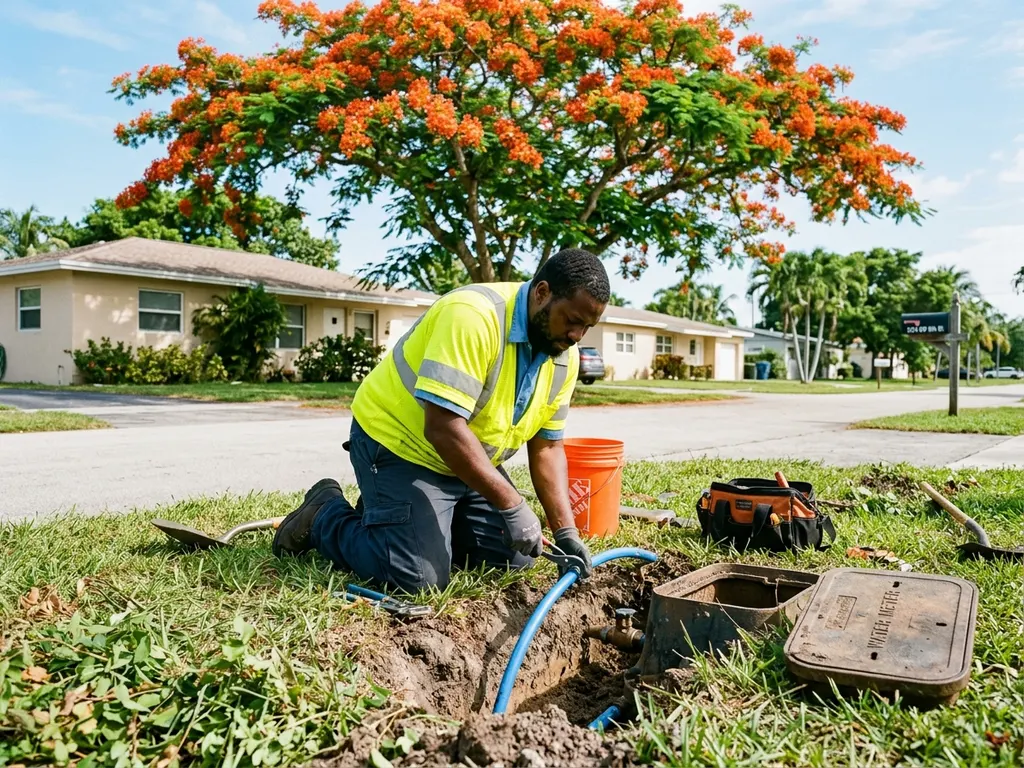
Pressure-test diagnostic, locate, written quote, four method options. Diagnosis included with every repair. Florida-licensed and permitted.
Get started with Main Water Line Leak Repair in Florida now; Leak Repair Florida is standing by. Main Water Line Leak Repair in Florida always means one call, one technician, one invoice.