Serving all 674 Florida citiesLicensed · Insured
Open 24/7 · Same-Day Service(407) 469-7996
Pipe Leak Repair · Every Material, Every Florida City

Pipe Leak Repair in Florida

Pipe Leak Repair in Florida means fast dispatch and a technician who has seen this exact problem before. That is what sets Pipe Leak Repair in Florida apart from a general handyman call.

Same-Day ResponseAny hour, 7 days a week
Licensed & InsuredFlorida technicians
No Overtime FeesSame rate, day or night
5-Year WarrantyWorkmanship, in writing

A pinhole in a 1985 copper line in Lakeland is not the same problem as a stress-crack in a CPVC riser in Naples or a polybutylene "blue pipe" failure in a 1989 Polk County tract home.

7materialsPipe types we repair: copper L/M, CPVC, PVC, PEX-A, PEX-B, galvanized, polybutylene
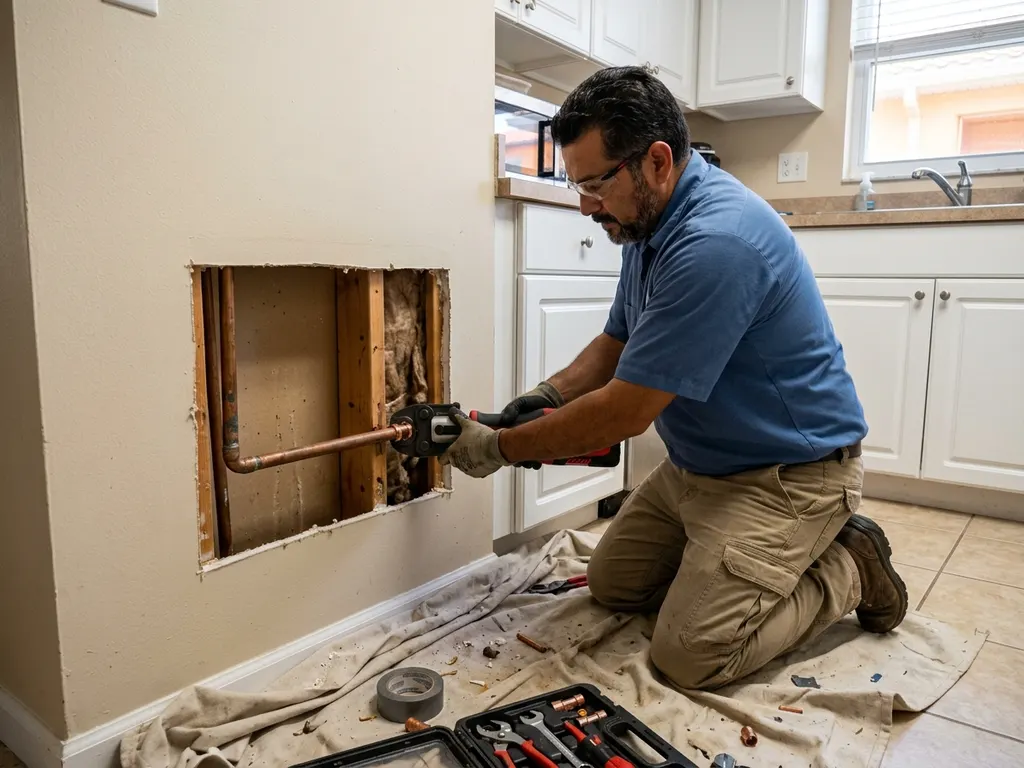
~12inTypical drywall opening on a surgical repair — smaller than the patch on a light switch box
85%
5yearWorkmanship warranty standard on press-fit and PEX expansion repairs
Material-specific diagnosis

What's in your walls — and what fails on it

Seven pipe materials cover roughly 99% of Florida residential plumbing. Each has a distinct failure signature and a distinct right-answer repair. We diagnose before we quote.

Type L Copper

The workhorse of Florida residential supply plumbing through the 80s and 90s. Half-inch and three-quarter-inch sweat-fitted joints, soldered with lead-free flux post-1986. Pinhole failure pattern is well documented: acidic Florida water (pH below 7) eats from inside, occasionally exterior flux residue accelerates it from outside.

Type M Copper

Thinner-wall copper. Code allows it for residential supply but it pinholes meaningfully faster than Type L because there's less metal to eat through. Many tract-home builders used Type M in the 90s to cut material cost. The result: a generation of Florida homes hitting failure age right now.

CPVC (cream / tan)

The cream-colored rigid plastic that replaced copper in many Florida tract builds. Cheap, easy to install, but goes brittle with UV exposure (attic installs especially) and concentrates stress at glued elbows. The fitting joint cracks before the pipe itself does — failure usually shows up at an elbow behind a wall.

PVC schedule 40

White rigid PVC is drain-waste-vent (DWV) only — not pressurized supply. Florida code prohibits PVC for supply. Failures here are slow and gravity-driven: cracks at the trap, separated joints in the attic where settlers' settling has moved the pipe.

PEX-A (Uponor red/blue)

The flexible cross-linked polyethylene line in red (hot) and blue (cold). Uponor's PEX-A uses cold-expansion fittings that grip the pipe back tighter than the original wall. Almost never fails on its own — the failure modes are rodent chewing in attic spaces and UV embrittlement when installed outdoors.

PEX-B (crimp / clamp)

PEX-B uses crimped or clamped rings to grip the pipe — different chemistry than PEX-A. Slightly stiffer, slightly more failure-prone at fittings because ring tightness varies with installer skill.

Galvanized steel

Threaded steel pipe coated in zinc. Used in pre-1955 Florida construction. Every galvanized line in a Florida home is past its design life. Failure looks like brown water from the tap, dropping pressure across fixtures, and eventually exterior rust pinholes.

Polybutylene "blue pipe"

Florida had one of the heaviest polybutylene installations in the U.S. (1978–1995, gray pipe with acetal fittings on supply, "blue pipe" outside the home). Cox v. Shell class action settled $1B in 1995 confirming the material fails. Estimated 250,000+ Florida homes still have it.

The chemistry of a copper pinhole

How a perfectly good copper pipe fails in eight years instead of forty

Florida's water and soil chemistry isn't friendly to copper.

Aggressive water meets the inside wall

Florida treated water is naturally on the acidic side (pH 5.8–6.8 vs ideal 7.0–7.5). Chlorine and chloramine added at the treatment plant compound the corrosion potential. Day-1 attack on Type M copper begins immediately.

Pitting microcells form (years 1–5)

Microscopic anodic and cathodic regions develop on the inside wall. Copper ions dissolve at the anode, depositing as a thin scale layer. Outwardly invisible — but the pitting depth measurably increases each year.

Stagnation accelerators (years 5–15)

Dead legs, summer-home stagnation, and undersized recirculation accelerate the pitting at low-flow spots. A 30-foot run that sits 8 hours overnight pits faster than the bus line that's used three times a day.

Wall breach — pinhole (years 18–30)

The deepest pit finally reaches the outside wall. Pressurized water finds the breach and the leak begins — often as a slow weep behind drywall that grows for weeks before staining shows up.

Where pipe leaks hide

Six locations where Florida homes hide a leak the longest

By the time you see water, the leak has been working for an average of 11 days. Knowing where to look shortens that.

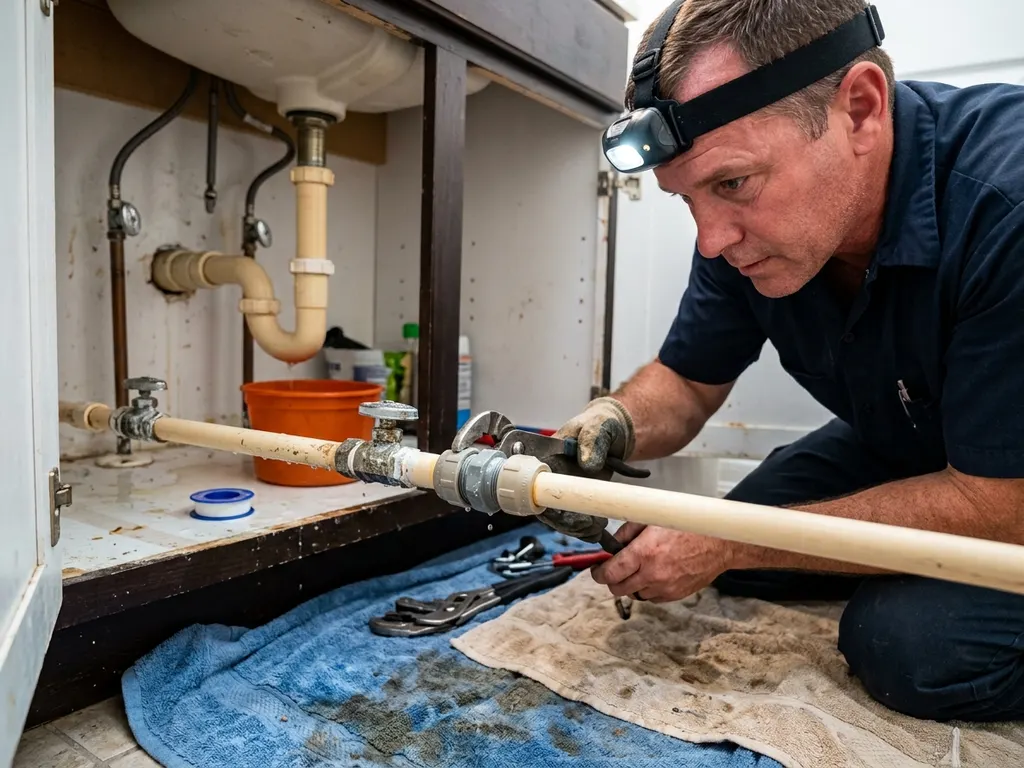
Under-sink supply riser

Behind the cabinet wall where the supply riser elbows into the angle-stop. The cabinet floor hides the leak until it migrates to baseboard or floor framing.

Attic PEX or CPVC run

Florida attics hit 130°F+. UV from soffit gaps embrittles plastic. Rodents chew exposed PEX. A 0.5mm crack drips on insulation for weeks before the ceiling stains.

In-wall stack joint

Where a horizontal run tees off the vertical riser inside a wall. Sweat joint cracks from thermal cycling, then drains down inside the wall cavity instead of out into the room.

Behind shower valve

The 2-handle or single-handle mixing valve has 3–4 connections behind tile. Solder joints there bear thermal cycling on every shower. First sign: a soft spot in the bathroom wall.

Upstairs supply over a downstairs ceiling

Two-story homes only. Supply line in the upstairs joist bay leaks down into the ceiling drywall below. Brown ring appears, then expands. Drywall fails in 4–8 hours.

Water heater connections

The hot and cold connections at the top of the water heater. T&P relief valve. Drain pan. Almost always a fitting issue, not the tank itself. Garage flooding is the symptom.

When a $400 surgical repair is the right move — and when it isn't

The most expensive choice on the table is a series of three or four spot repairs over the next 24 months. Here's how we decide.

Surgical repair almost always

First leak One pinhole or one fitting failure on otherwise sound plumbing is a maintenance event, not a system failure. We do a 4–6" wall opening, fix the line, patch with drywall hot mud + tape + paint-ready finish, and warranty the work 5 years.

Surgical repair is the standard answer

Copper L · CPVC · PEX-A under 20yr These materials should last another 15–30 years. A single failure is statistical noise, not a system warning. Spot-repair, document for insurance, move on.

Every pipe material

Copper, PEX, CPVC and polybutylene — repaired right

From a single copper pinhole to a failing polybutylene system, we match the repair to the material and the age of the plumbing — not a one-size coupling.

  • Copper pinhole & joint repair
  • PEX & CPVC corrections
  • Polybutylene replacement
(407) 469-7996
pipe leak repair inside a South Florida home
Licensed& Insured
124 cities

Pipe Leak Repair in Southeast Florida

Atlantis Aventura Bal Harbour Bay Harbor Islands Belle Glade Biscayne Park Boca Raton Boynton Beach Briny Breezes Cabana Colony Canal Point Cloud Lake Coconut Creek Cooper City Coral Gables Coral Springs Country Club Cutler Bay Dania Beach Davie Deerfield Beach Delray Beach Doral El Portal Florida City Fort Lauderdale Fountainebleau Glen Ridge Golden Beach Golf Greenacres Gulf Stream Hallandale Beach Haverhill Hialeah Hialeah Gardens Highland Beach Hillsboro Beach Hollywood Homestead Hypoluxo Indian Creek Islandia Juno Beach Jupiter Jupiter Inlet Colony Kendale Lakes Kendall Key Biscayne Lake Clarke Shores Lake Harbor Lake Park Lake Worth Beach Lantana Lauderdale Lakes Lauderdale-by-the-Sea Lauderhill Lazy Lake Lighthouse Point Loxahatchee Loxahatchee Groves Manalapan Mangonia Park Margate Medley Miami Miami Beach Miami Gardens Miami Lakes Miami Shores Miami Springs Miramar North Bay Village North Lauderdale North Miami North Miami Beach North Palm Beach Oakland Park Ocean Ridge Olympia Heights Opa-locka Pahokee Palm Beach Palm Beach Gardens Palm Beach Shores Palm Springs Palm Springs North Palmetto Bay Parkland Pembroke Park Pembroke Pines Pembroke Pines East Pinecrest Plantation Pompano Beach Riviera Beach Royal Palm Beach Sea Ranch Lakes South Bay South Miami South Palm Beach Southwest Ranches Sunny Isles Beach Sunrise Sunset Surfside Sweetwater Tamarac Tamiami Tequesta Three Lakes University of Miami University Park Virginia Gardens Wellington Wellington East West Miami West Palm Beach West Park Westchester Westlake Weston Westwood Lakes Wilton Manors
29 cities

Pipe Leak Repair in Treasure Coast

76 cities

Pipe Leak Repair in Southwest Florida

10 cities

Pipe Leak Repair in Florida Keys

87 cities

Pipe Leak Repair in Tampa Bay

24 cities

Pipe Leak Repair in Nature Coast

106 cities

Pipe Leak Repair in Central Florida

25 cities

Pipe Leak Repair in East Central Florida

24 cities

Pipe Leak Repair in Space Coast

19 cities

Pipe Leak Repair in North Central Florida

65 cities

Pipe Leak Repair in North Florida

85 cities

Pipe Leak Repair in Florida Panhandle

Why specialists

Why pipe-leak repair done right is more than "cut and replace"

A pipe leak is a clue. We treat it as one.

Material-correct tooling

ProPress press-tool for copper, Uponor ProPEX expander for PEX-A, calibrated crimp tools for PEX-B, solvent welds for CPVC, ratcheting threader for galvanized. We bring the right tool on every truck — no improvising with what's left in the van.

Adjuster-ready paperwork

Photo of the failed section before and after, moisture readings on adjacent drywall, itemized invoice formatted for HO-3 carriers. The job ends with a packet your insurance can process on first review.

pipe leak repair inside a North Florida home
Open24 / 7
Diagnose first

We locate the pinhole before we open the wall

Pressure isolation and acoustic tracing find the exact failure point, so a single tile or section of drywall comes out — not the whole run.

  • Acoustic pinhole tracing
  • Minimal-access repairs
  • Written diagnostic first
Call (407) 469-7996
Pipe repair FAQ

What Florida homeowners ask about pipe leaks

Ten common questions. If yours isn't here, call (407) 469-7996.

FAQ

Frequently asked questions

Talk to a specialist
How do you know what pipe material I have without opening a wall?

Most of the time we can tell from the visible runs at the water heater, under-sink valves, and exposed bibs outside. Color and size are diagnostic: red/blue flexible = PEX, cream rigid = CPVC, copper-color metal = copper, white rigid = PVC (drain only), gray flex (acetal fittings) = polybutylene, threaded galvanized-gray = galvanized. We verify in-wall via the smallest cut needed.

What is "polybutylene" and why does everyone freak out about it?

Polybutylene was a flexible plastic supply pipe used heavily in Florida from 1978–1995. It chemically reacts with chlorinated water and gets brittle. A 1995 class-action (Cox v. Shell, $1B settlement) confirmed systematic failure. Estimated 250,000 Florida homes still have it. Insurance carriers often refuse new policies on PB homes. Spot-repair is throwing money at a system that will keep failing.

What's "ProPress" and why does it matter?

ProPress is a hydraulic copper-press-fit system. Instead of using a torch to sweat-solder copper joints (open-flame work near drywall, insulation, and old wood framing), the tool presses a special fitting onto the pipe with a calibrated jaw. No flame, no fire-watch, no smell of flux. Same pressure rating and life as a soldered joint. We bring it on every copper job.

Will insurance cover the repair?

Florida HO-3 typically covers the resulting water damage (drywall, flooring, contents) but excludes the failed pipe itself. Two exceptions: (a) "sudden & accidental" supply-line bursts are usually covered including the pipe, (b) some carriers offer a buried/concealed-pipe rider. Our paperwork is formatted for adjuster review on first submission.

How big is the wall opening for a typical repair?

Goal is the smallest cut that lets us work cleanly. For a supply-line pinhole in copper or CPVC: usually a 6"x12" rectangle on the wall surface. We patch with hot mud, tape, and 2 coats of finish ready for paint. The patch is included in the quote unless you've specified you'll handle drywall separately.

How long does a typical pipe repair take?

Under-sink supply riser swap: 30–60 min. Single in-wall pinhole repair: 1.5–3 hours including drywall patch. Shower-valve replacement: 3–5 hours.

Can a single fitting that keeps leaking actually fail the system?

Yes. A leaking fitting is rarely just that fitting — it's usually a sign the soldering work on adjacent joints was rushed, or the pipe diameter is wrong for the flow rate, or the original installer over-torqued threads. We inspect the surrounding 4–6 feet on every repair to catch the second failure before it floods you.

What if you cut the wrong pipe?

We label, photograph, and pressure-test before cutting on every job. If something we didn't intend to expose gets damaged (the gas line that the previous installer ran through the wall cavity, for example), our liability insurance covers the repair. In 15 years we've had this happen twice — both fully resolved without homeowner cost.

What's the warranty on a pipe repair?

5 years on the workmanship of any surgical pipe repair (copper press, PEX expansion, CPVC reglue). We document the warranty on every invoice and we honor it if a repair fails — we come back at no charge to redo it.
Get the diagnosis before you authorize the repair.

Material ID. Failure mode. Written, flat-rate, before any wall opens.

Leak Repair Florida keeps Pipe Leak Repair in Florida appointments open 24/7 for exactly this reason. Pipe Leak Repair in Florida means licensed, insured technicians — no subcontractors, ever.

Call (407) 469-7996